

There is no responsible single answer to “How often should I service my car?” The interval depends on the exact vehicle, powertrain, component, elapsed time, mileage, operating conditions, and sometimes a condition-monitoring system. A round number repeated by a shop, friend, or search result may be convenient, but convenience does not make it applicable.
The practical answer is a decision process: identify the correct factory schedule, determine which operating conditions apply, understand what a dashboard reminder does, and require evidence for recommendations outside the schedule.
Find the schedule for the exact vehicle
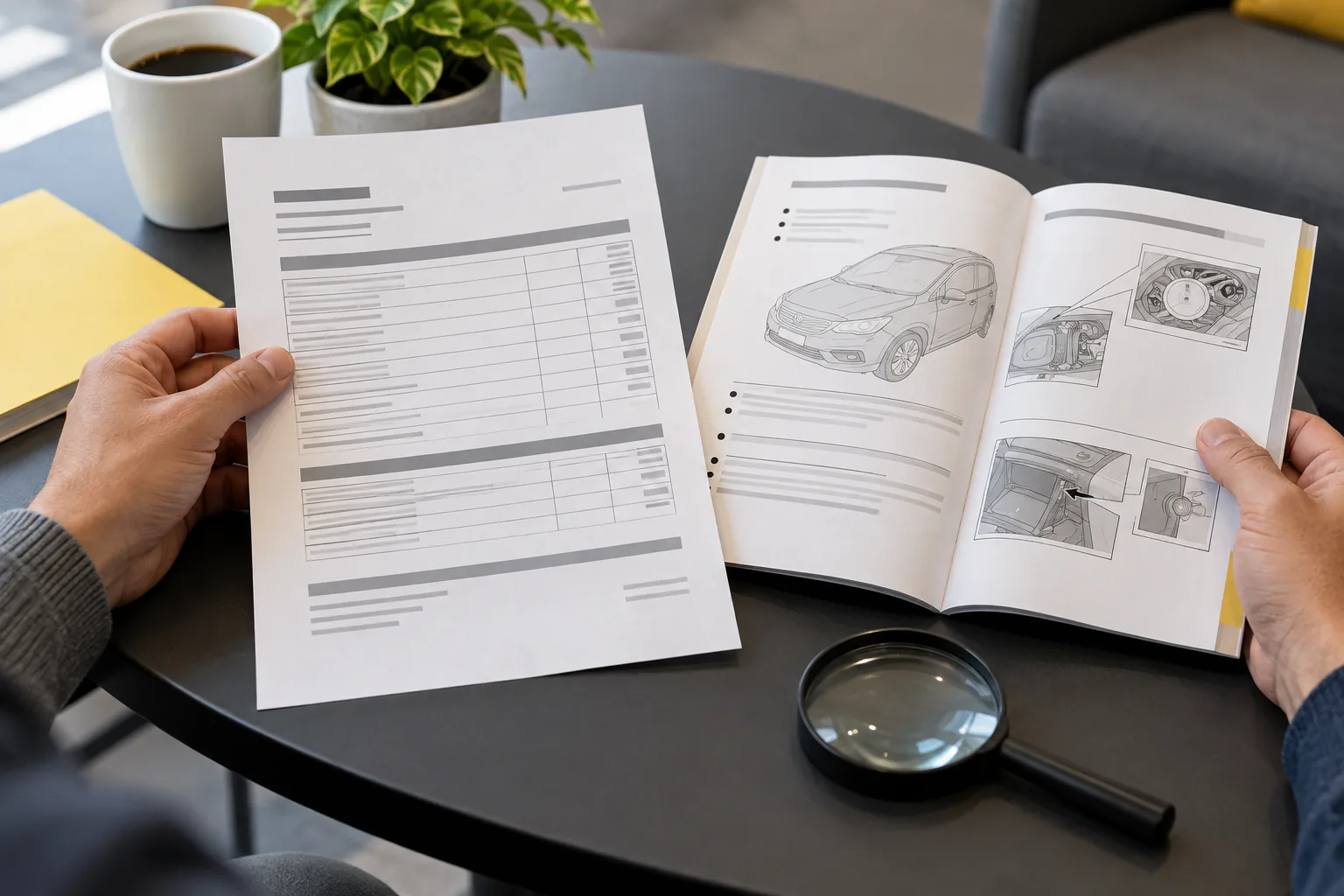
Start with model year, make, model, powertrain, and sales market. A hybrid and gasoline version can differ. So can two neighboring model years. Use the manufacturer's owner portal and look for an owner's manual plus a maintenance, warranty, or service guide.
Verify the document title and selected vehicle before extracting an interval. If an owner portal asks for a VIN, use it privately on the official site. Save a PDF or record the page, section, URL, and access date. The schedule is only useful when you can later prove which vehicle it described.
Read the verbs. “Inspect,” “replace,” “rotate,” “adjust,” and “check” are not synonyms. An inspection interval does not mean the part must be replaced at every visit. Likewise, a replacement line may contain a time limit, mileage limit, and “whichever comes first” condition that should remain attached to the item.
Decide which operating-condition schedule applies

Manufacturers may provide a standard schedule and additional requirements for defined conditions. Those definitions vary. They can include particular patterns of towing, heavy loading, dusty roads, extensive idling, repeated short trips, low speeds, or extreme conditions, but no generic list overrides the words in your manual.
Match actual use to the manufacturer's definition. Record the reason: “tows within the condition described on page X” is more defensible than “driving is severe.” Reassess when the vehicle's role changes. A car that begins regular towing or moves from a mild climate to a dusty work site may need a different branch of the schedule.
Do not assume that low mileage means no maintenance. Time can govern some fluids, materials, inspections, and warranties. At the same time, do not invent time-based replacement where the manufacturer has not specified one. Track each item by its actual trigger.
Understand dashboard reminders
A maintenance reminder can be mileage-based, time-based, condition-estimated, or tied to a particular system. The owner's manual should explain what it monitors and how it is reset. It may not represent a full inspection or every item in the maintenance guide.
A reminder also does not prove service occurred. If a light was reset without the work, the history remains incomplete. After service, keep the invoice and record date, mileage, item, and specification. If the reminder appears unexpectedly, confirm its meaning before clearing it.
Do not confuse a maintenance reminder with a malfunction or safety warning. A check-engine, brake, oil-pressure, temperature, or charging-system warning has its own model-specific response. Waiting for the next scheduled visit may be inappropriate.
Evaluate recommendations that go beyond the schedule
The FTC advises comparing shop-created schedules with the manufacturer's recommendations and asking the shop to explain additional service. That does not mean every extra recommendation is a sales tactic. A measured defect, active leak, contamination, damage, recall, technical update, or actual operating condition may justify earlier work.
Ask these questions:
- What condition did you observe?
- What measurement, test, image, or code supports it?
- Is this scheduled, condition-based, or a repair?
- Which manufacturer or technical specification applies?
- What is the safety or cost consequence of waiting?
- Is there a warranty, recall, or service-contract issue?
For expensive or complicated work, the FTC suggests considering a second opinion. A diagnostic-only shop may be useful in some situations, but ask about diagnostic charges and deliverables first.
When the vehicle is new to you
A used vehicle with incomplete records creates a special problem: the schedule tells you what should have happened, not what did happen. Begin with documents, current mileage, recall status, dashboard messages, and a qualified inspection appropriate to the vehicle. Do not reset the history by assuming that every scheduled item is either complete or overdue.
Group unknowns by how they can be resolved. An invoice or manufacturer history may verify some work. A measurement or inspection may establish present condition for tires, brakes, filters, or accessible components. Other systems may require specialized testing or a conservative decision based on the manual and professional advice. Record the method used.
If several items remain uncertain, prioritize active safety findings and clearly due manufacturer requirements. Ask whether combining work saves labor without adding unnecessary parts. Preserve baseline date, mileage, specifications, and invoices from this point forward. The objective is not to reconstruct an unknowable past perfectly; it is to create a defensible present state and prevent the same uncertainty from returning.
Build one documented answer
For each maintenance item, write one line containing the source, trigger, current mileage or date, applicable condition, last verified completion, and next review. For example: “Engine oil—follow the exact 2021 maintenance guide and vehicle reminder; special-condition branch checked; last invoice at X miles; review at the earlier applicable trigger.” Use real values from your records rather than copying the example.
If history is unknown, label it unknown. Do not manufacture certainty from a windshield sticker or verbal memory. Ask what inspection or evidence can establish the present condition, and prioritize active safety findings before low-consequence uncertainty.
Why the answer changes from item to item
“Service the car” is not one operation. Tire pressure is an owner measurement, tire rotation follows a schedule or wear-management plan, brake service responds to inspection and symptoms, engine oil follows vehicle-specific rules, and some systems may be sealed or absent. Bundling everything into one interval hides those differences.
The best service frequency is therefore not the shortest or longest number. It is the set of triggers supported by the correct factory documents, adjusted only when documented conditions or evidence justify it. That approach gives you a clear basis for reminders, shop conversations, and warranty records without pretending that one mileage applies to every car.
Recheck the decision whenever the vehicle's use changes. A new towing role, sharply higher annual mileage, long storage period, or move to a different climate may affect which documented condition applies. Update the schedule branch, not the underlying evidence.