
A useful maintenance record is not a shoebox of receipts and not a list of dates with no evidence. It is a small system that lets you answer four questions: what happened, what proves it, which specification applied, and what still needs attention. The system can be paper or digital. Consistency matters more than the app.
Keep records for shop work, owner-performed work, recalls, warranty matters, measurements, and unresolved observations. Do not merge those categories into one vague “service history.” They carry different kinds of evidence.
Separate the event log from the evidence files
Create an event log with one row per visit or action. Include date, odometer, item, result, provider or person, cost if useful, and next trigger. Keep source documents in a linked folder: invoices, completed repair orders, parts receipts, photographs, warranty correspondence, and recall completion notices.
Use stable filenames such as `2026-10-2042180mibrake-inspection_shop-name.pdf`. Avoid filenames that contain only “scan” or “receipt.” Back up digital records in a second location you control. If using a manufacturer or shop portal, export important documents because access can change when an account, dealer, or vehicle ownership changes.
The FTC says a completed repair order should describe the work, list supplied parts and their costs, show labor charges, and include odometer readings. Review it before filing. If the line says only “service package,” ask for the actual operations and parts.
Record shop work without rewriting the invoice
In the event log, summarize what the document proves. Distinguish diagnosis from repair and recommendation from completion. “Technician recommended front pads” is not the same as “front pads replaced.” “No leak found during visit” does not prove that a reported intermittent leak never occurred.
Record measurements when provided: remaining pad thickness, tire tread depth, battery test result, fluid condition test, alignment readings, or diagnostic codes. A code is not automatically a failed-part diagnosis, so preserve the technician's conclusion separately from the raw result.
If a shop recommends additional work, capture the stated reason and priority. Ask whether it is factory scheduled, required by an observed defect, related to a recall or warranty, or preventive advice outside the schedule. The record should preserve the distinction rather than decide it silently.
Record DIY work with the same discipline
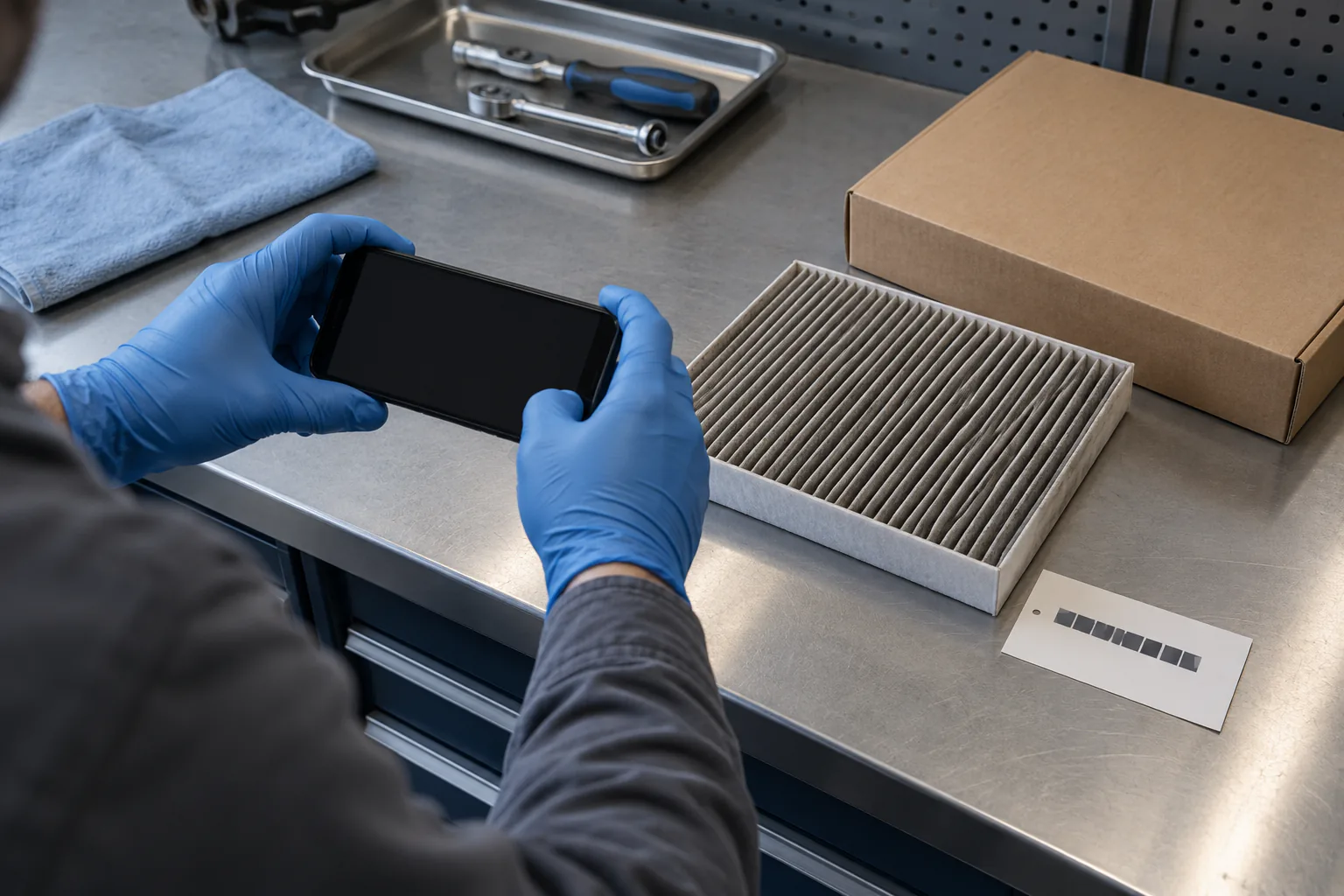
For owner-performed maintenance, record the exact item, date, mileage, part number or fluid specification, quantity when relevant, and the manual section followed. Keep the receipt and packaging label photograph. Do not claim an inspection or torque step that was not actually performed.
Write down problems encountered: a damaged fastener, spilled fluid, warning message, missing clip, or uncertainty about completion. An honest incomplete record is safer than a polished fictional one. For tasks involving vehicle lifting, brakes, fuel, airbags, high voltage, or hot pressurized cooling systems, a record system does not make the work suitable for an untrained person.
If another person performs the work, name the role accurately. “Friend replaced filter” is more truthful than presenting it as professional service. Warranty requirements vary, so consult the applicable warranty document instead of assuming that a receipt alone guarantees coverage.
Maintain a specification sheet
Create a separate page for model-specific facts you repeatedly need: tire-label pressures, approved oil grade or standard, coolant specification, bulb or wiper details, and torque values only for tasks you are qualified to perform. Attach the document title, model year, page or official URL, and access date.
Do not copy specifications from a similar vehicle. Recheck after a manual revision, powertrain change, replacement wheel or tire setup, or move to another market. Mark “if equipped” systems. The sheet is a retrieval aid, not an authority independent of the current manual.
Keep unresolved issues visible

Create an open-issues list with date first observed, operating conditions, exact symptom, frequency, related warning or message, evidence, safety status, and next action. Close an issue only with a documented resolution or an explicit decision to monitor it.
For example, “vibration” is too broad. A better entry records whether it appeared while braking, at a particular speed range, after a tire event, or with a warning light. Do not recreate a dangerous symptom for the record. If braking, steering, tire integrity, overheating, smoke, or fuel odor is involved, safety action takes priority over better notes.
Make records useful during a shop visit
Before an appointment, export a short packet rather than handing over an unfiltered archive. Include the concern timeline, relevant prior work, current mileage, exact dashboard message, and applicable warranty or recall documents. State what is observed without prescribing a repair: “grinding during braking began at this mileage” is more useful than “replace the front rotor” when no diagnosis has been made.
After the visit, compare the estimate or completed order with the concern you reported. Note whether the shop reproduced it, what tests were performed, what was found, which work was approved, and what remains open. If a recommendation is deferred, record the reason and review trigger. Do not mark the underlying symptom resolved simply because an appointment occurred.
For a second opinion, share the same factual packet so both providers begin with comparable information. Keep each conclusion attributed to its source. If the opinions conflict, the record should show the disagreement rather than blending them into a false consensus.
Audit the record twice a year
Sort events by date and mileage, then look for contradictions: a later odometer lower than an earlier one, a reminder with no completion evidence, a recommendation mistakenly marked done, or two different specifications for the same system. Confirm that files open and backups exist.
Compare the log with the manufacturer's current schedule and open recall status. Add future triggers to a calendar, but keep the history separate. A calendar predicts; the record proves.
When selling the vehicle, share service evidence after removing personal data, payment information, account identifiers, and unrelated documents. Never share a folder blindly.
A complete record does not mean every blank is filled. It means known facts are supported, uncertainty is labeled, unresolved issues remain visible, and the next person can reconstruct each decision without guessing.
The discipline also protects against accidental repetition. Before authorizing a service, search the record for the last verified completion, the exact specification, and any warranty on prior work. A five-minute review can reveal that a recommendation needs clarification or that a recurring symptom was never actually closed.