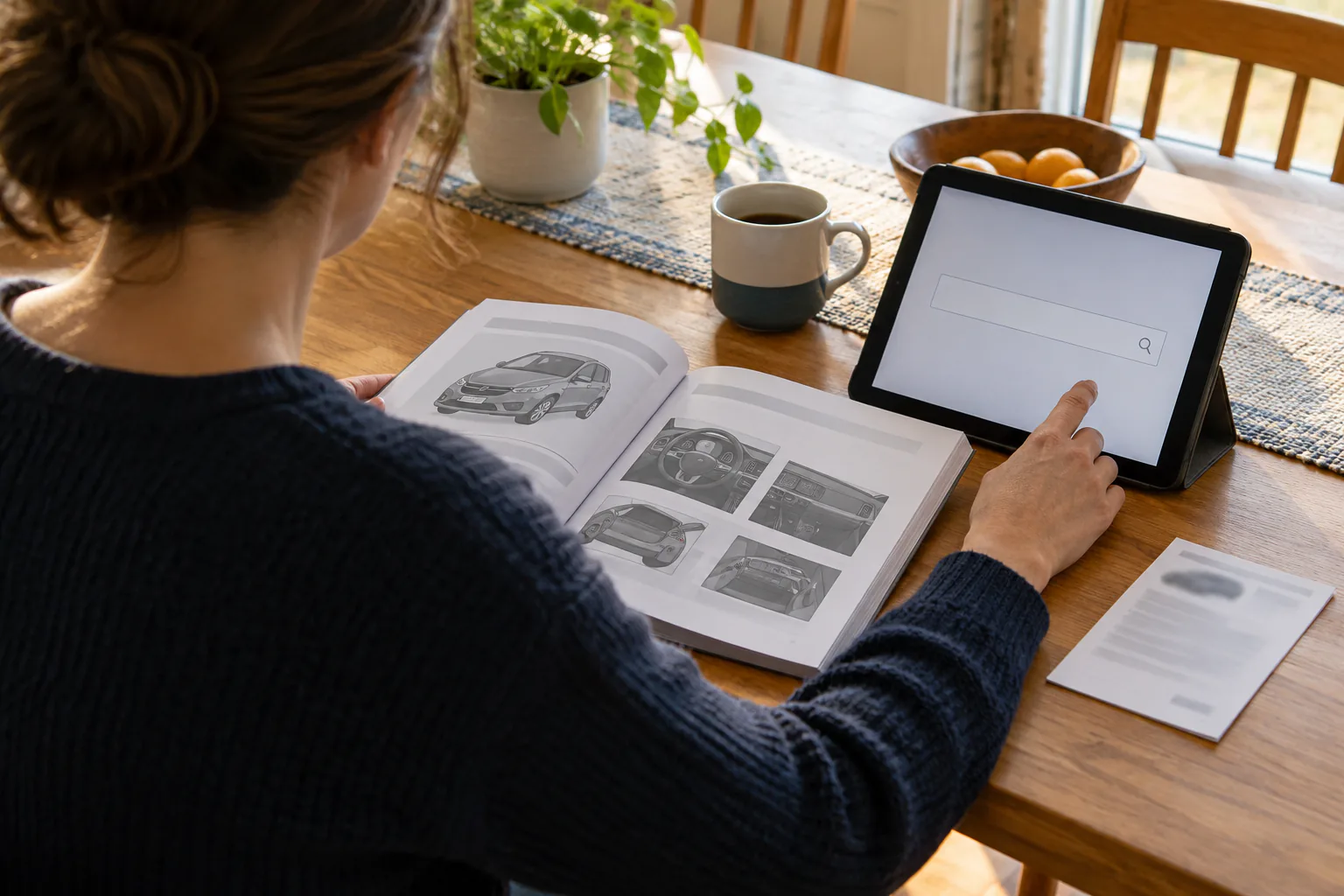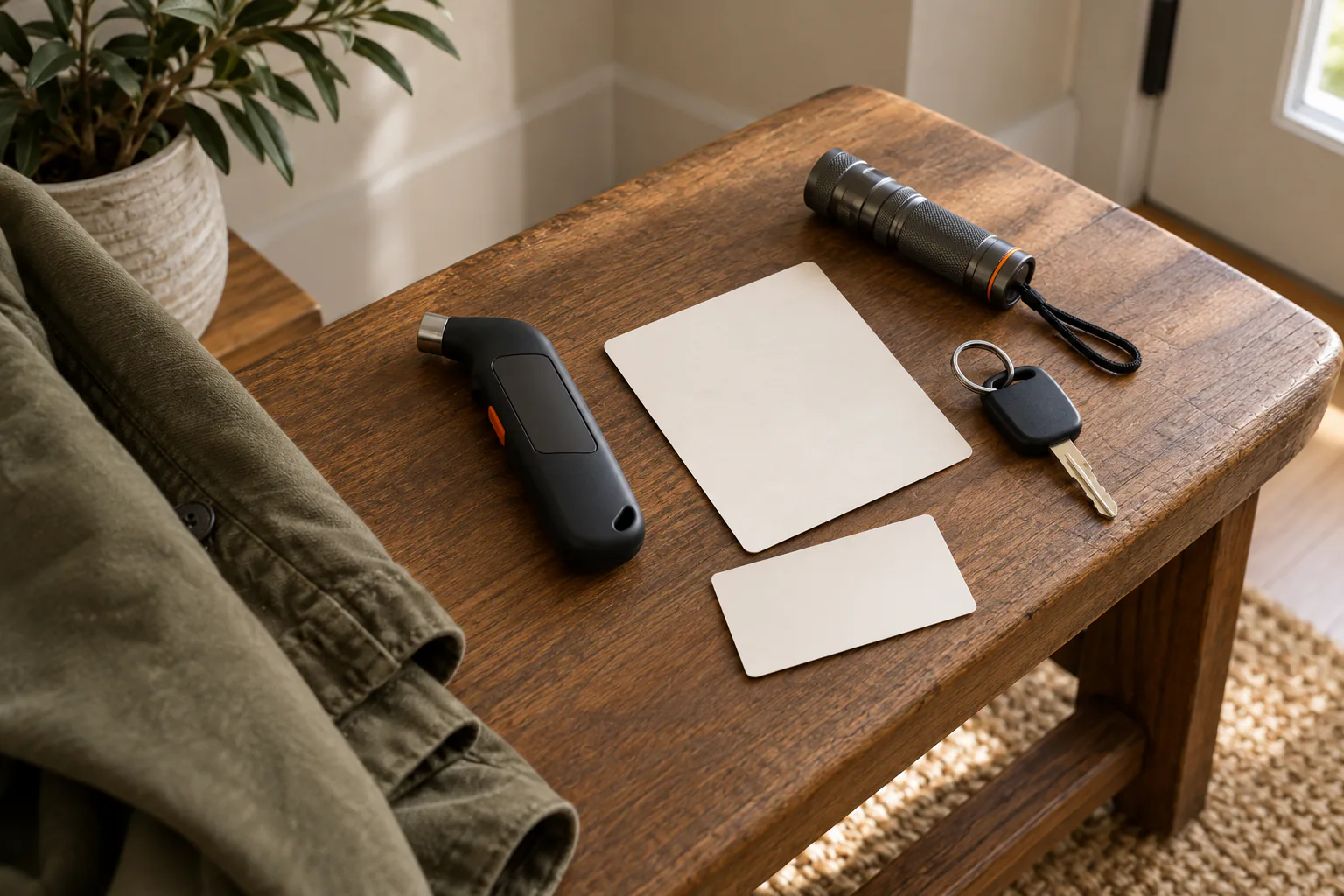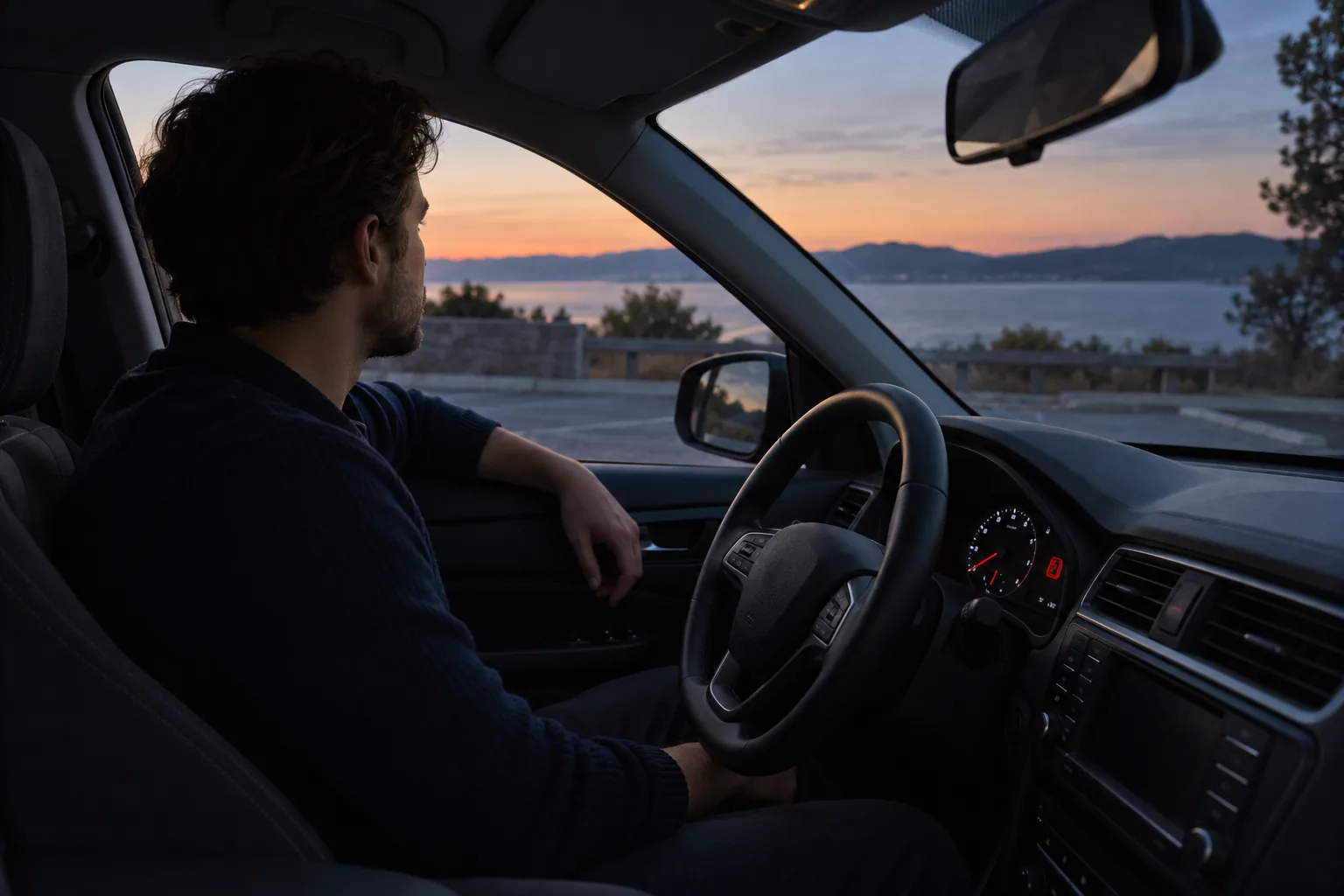

Car maintenance feels unmanageable when every warning, interval, fluid, and shop recommendation arrives as a separate demand. Your first session does not need to solve all of that. A useful first 30 minutes should produce three things: an accurate identity for the vehicle, reliable places to look up information, and one sensible next action. You do not need tools, replacement parts, or the confidence to diagnose a machine.
The goal is control, not mechanical mastery. Work with the car parked safely on level ground, the engine off, and the parking brake applied. If the vehicle is in traffic, smoking, leaking fuel, overheating, or behaving unsafely, skip this routine and arrange appropriate help.
Minutes 0–8: identify the exact vehicle
Write down the model year, make, model, current odometer reading, and powertrain if you know it. A hybrid, battery-electric vehicle, diesel, and gasoline model can carry different maintenance instructions even when the badge looks similar. Do not guess the year from the purchase date.
Locate the vehicle identification number, or VIN, but treat it as private account information. It is commonly visible near the lower windshield and on registration documents. Use it on an official manufacturer or government lookup page; do not publish it in a forum or photograph. In the United States, NHTSA's recall lookup accepts a VIN and reports unrepaired safety recalls. A recall is not routine maintenance, but an open recall belongs on your action list.
Also find the tire and loading information label, commonly on the driver's door or door pillar. For now, only note its location. The pressure printed on a tire sidewall is not the vehicle's normal inflation target; the vehicle label and owner's manual are the relevant references.
Minutes 8–15: find the documents that outrank generic advice

Search the manufacturer's official owner site for the exact year and model. Save the owner's manual, warranty or maintenance guide, and any separate service schedule. Toyota, Ford, and other manufacturers organize these materials differently, which is why a generic web checklist cannot be the final authority for your car.
Confirm that the document actually matches the vehicle. Look for the model year, market or country, engine or powertrain, and publication title. A search result may surface a manual for a neighboring year. That can be useful for discovery but should not quietly become your source of truth.
Create bookmarks with plain names such as “2022 Model Owner's Manual,” “Maintenance Schedule,” and “NHTSA Recall Check.” If the car came with printed books, note where they are kept. The Federal Trade Commission advises following the manufacturer's maintenance schedule for your type of driving and asking a shop to explain recommendations that go beyond it. That single rule prevents a large amount of confusion.
If the official portal offers several documents, save the maintenance or warranty supplement as well as the main manual. The schedule is sometimes located outside the operating manual, and a quick-start booklet may not contain enough detail for service decisions.
Minutes 15–23: make a one-page ownership record
Open a note, spreadsheet, or sheet of paper and create five fields:
- Current date and odometer reading
- Last service you can verify
- Next scheduled item you can verify
- Current observation or concern
- Source for each statement
“Verify” matters. A windshield sticker is a reminder, not a complete service history. A seller's verbal statement may be useful context, but it is not the same as an invoice. If you do not know when something was done, write “history unknown.” That wording is more useful than an invented date because a technician can help you decide what evidence or inspection is appropriate.
For completed shop work, keep the repair order. The FTC says a completed order should describe the repairs, supplied parts, costs, labor charges, and odometer readings. A photograph or scan stored with a clear filename is enough to start. Record-keeping is not paperwork for its own sake; it stops the same uncertainty from returning at every visit.
Minutes 23–28: make five no-tools observations
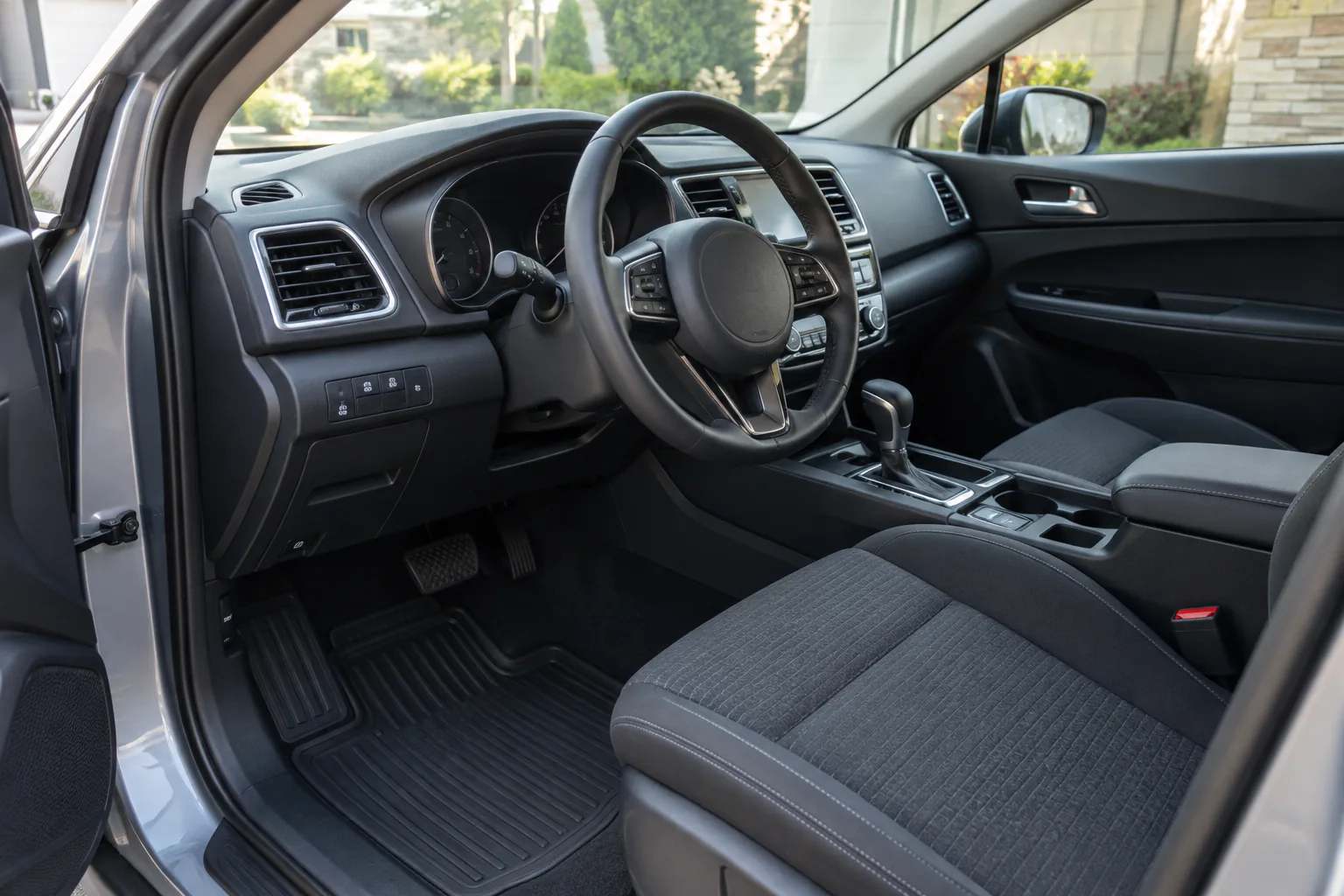
Walk around the parked vehicle without crawling underneath it or opening a hot engine compartment.
First, look at all four tires. Notice a visibly low tire, a cut, a bulge, exposed material, or an object embedded in the tread. Visual inspection cannot establish correct pressure, but it can reveal a reason not to proceed normally.
Second, check whether the windshield, mirrors, lamps, and license plates are clear and intact. You may need another person to confirm brake lights. Do not stand behind a running vehicle in an enclosed space.
Third, look at the ground from a safe position. Clear water after air-conditioner use may be condensation, while a growing oily puddle or strong fuel smell needs attention. Do not touch or taste an unknown fluid.
Fourth, sit in the driver's seat and note warning messages before dismissing them. Photograph the whole display if safe to do so. The exact symbol, color, accompanying text, and operating condition are more useful than a memory that “a light came on.”
Fifth, notice changes in braking, steering, starting, visibility, or unusual odors from recent drives. Do not reproduce a dangerous symptom for testing. Write down when it occurred and what the vehicle was doing.
Minutes 28–30: choose one next action
Your result should fit one of three routes.
Continue and schedule. No urgent symptom is present, the vehicle behaves normally, and you have identified the next maintenance trigger from the correct manual. Put that date or mileage into a reminder.
Arrange an inspection. The history is unknown, a non-urgent change keeps returning, or a shop recommendation needs evidence. Ask for the reason, measurement, manual reference, and consequence of delaying the work. For expensive or complicated repairs, the FTC suggests considering a second opinion.
Stop using the vehicle normally. Choose this route for compromised braking or steering, a flashing critical warning paired with poor operation, smoke, a persistent fuel smell, overheating, a severely damaged tire, or an instruction in the owner's manual to stop. The manual's model-specific warning procedure takes priority over a general article.
Do not buy a large tool set, open pressurized cooling components, disconnect a battery, lift the vehicle, or start replacing parts during this first session. Those actions create new hazards without solving the information problem. After 30 minutes, success means that you know what car you have, where its rules live, what you have actually observed, and what happens next.