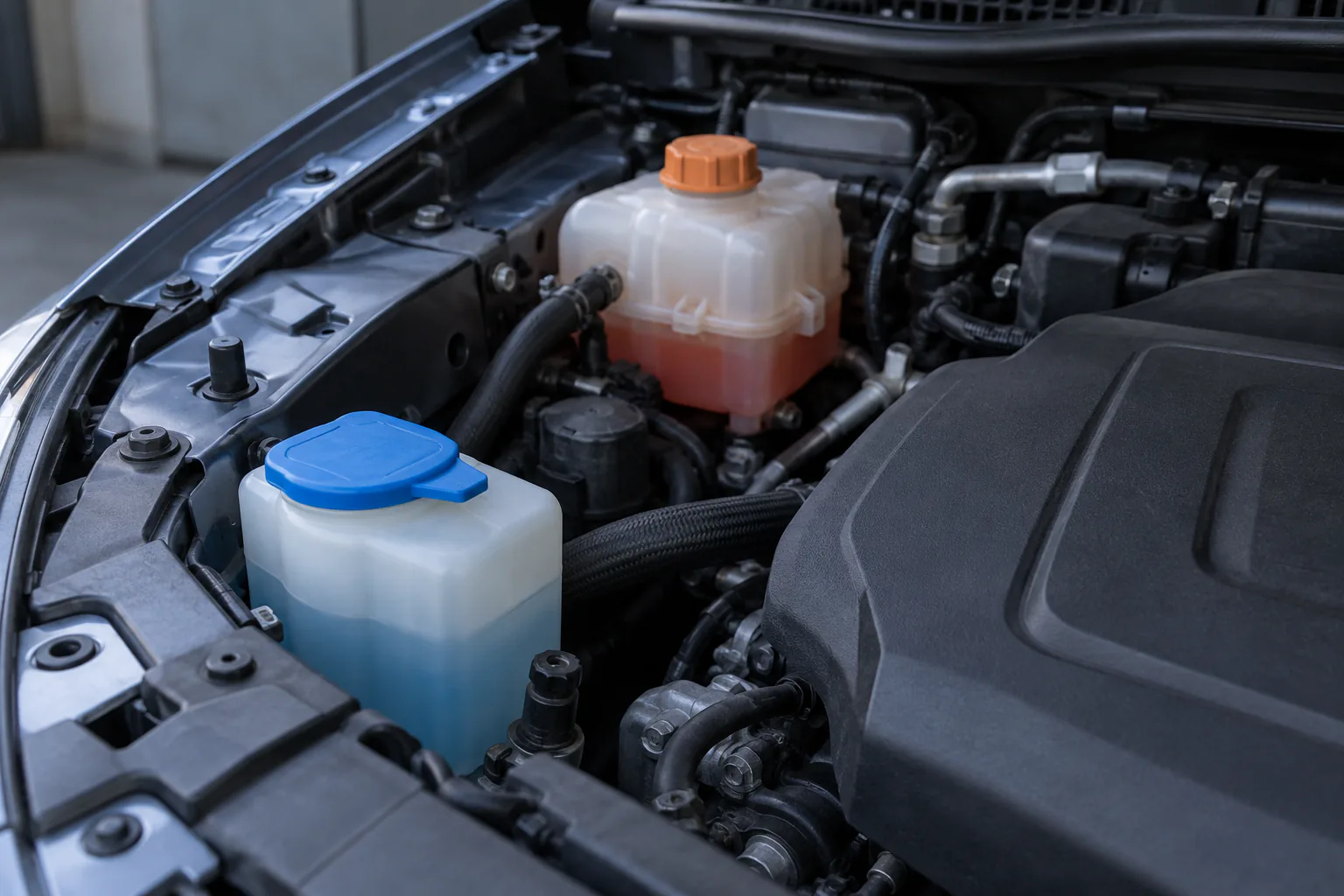
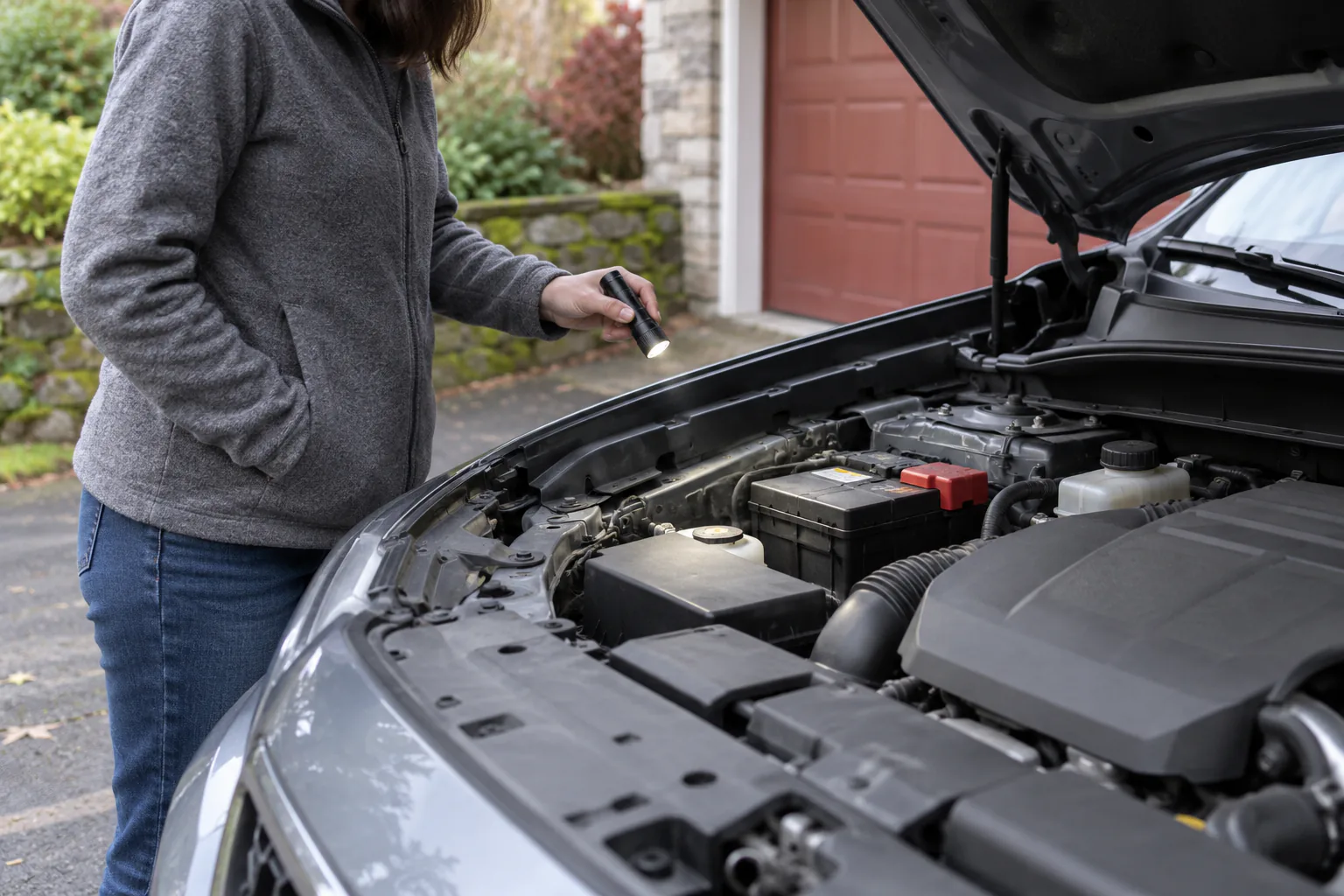
A home battery check should begin by identifying the battery and defining the boundary. This article covers an ordinary 12-volt battery only. Hybrids and electric vehicles also contain high-voltage systems that must not be opened, probed, disconnected, or treated as a larger version of a 12-volt battery.
The safest owner check has three zones: look without touching; test only with the correct manual, equipment, and knowledge; and stop where damage, high voltage, access, or symptoms make professional service appropriate.
Identify the system and location
Use the exact owner's manual. A 12-volt battery may be under the hood, in the trunk, below a seat, or behind a cover. Some vehicles provide remote jump terminals. Do not remove trim or covers not identified by the owner procedure.
Confirm that the component is 12-volt and note warnings about battery type, ventilation, memory settings, stop/start systems, registration, charging, and jump-starting. AGM and other designs can require compatible charging and replacement procedures.
Keep sparks, flames, smoking materials, jewelry, and metal tools away. Wear appropriate eye protection if the manual permits close inspection. Battery gas and electrolyte can be hazardous.
Look-only checks
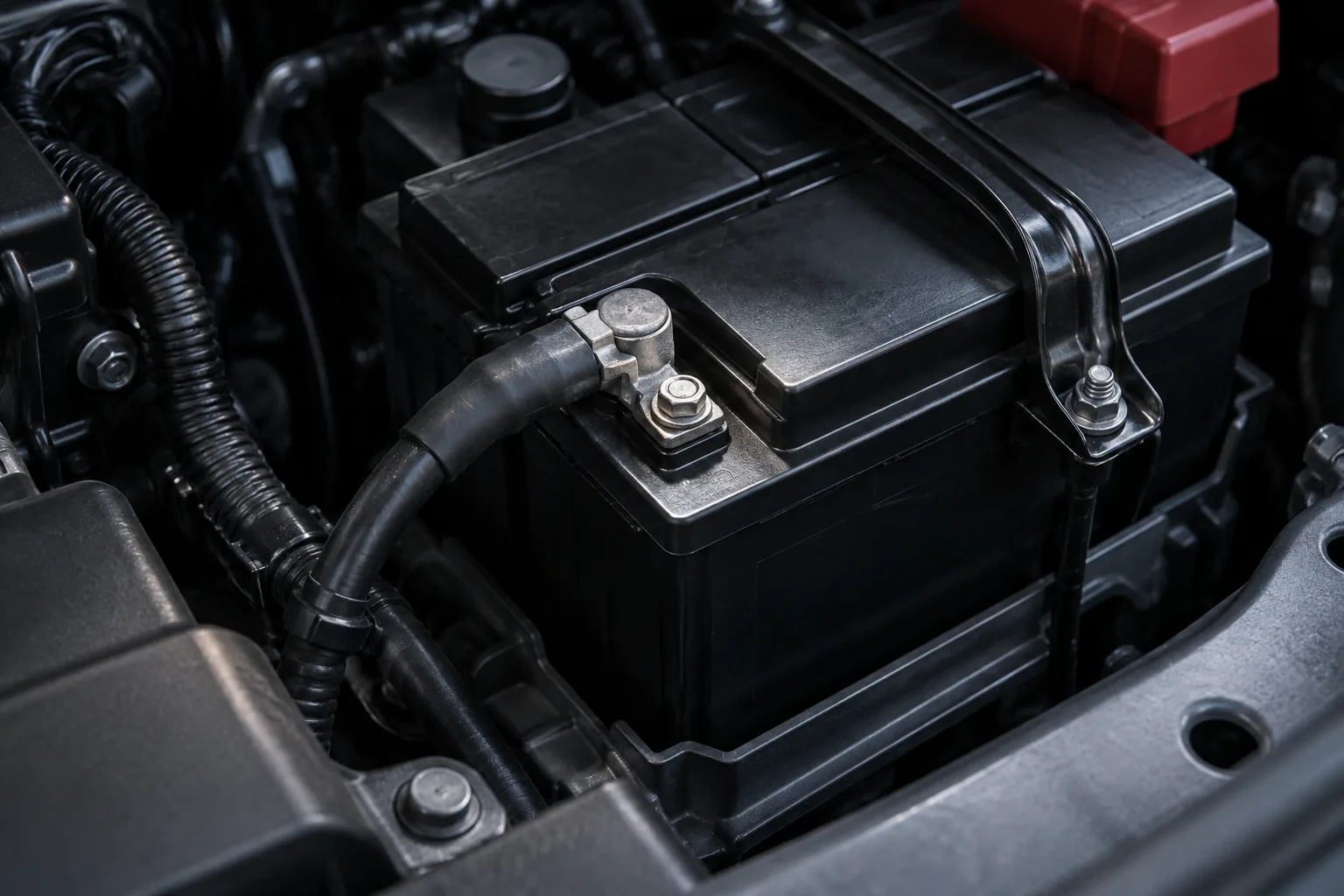
With the vehicle off and parked safely, look for a loose or damaged case, swelling, cracks, wetness, heavy corrosion, damaged cables, or an insecure hold-down. Do not touch leaked material or lean over a damaged battery. Arrange qualified help.
Check whether terminals and cables appear secure without twisting them. The FTC notes that loose or corroded connections can make a battery or alternator appear defective. That means a no-start should be tested, not automatically solved with a new battery.
Observe starting behavior and dashboard messages. Slow cranking, repeated clicking, dimming, or intermittent electrical behavior can support a test request, but each has multiple causes. A battery-shaped warning while driving often relates to the charging system, not simply stored battery charge.
Voltage testing has limits

If the manual permits access and you know how to use a suitable digital multimeter safely, a resting-voltage reading can be one data point. Turn loads off, follow the meter instructions, keep probes from bridging terminals, and use the designated points. Never probe orange high-voltage cables or unfamiliar terminals.
Resting voltage varies with battery chemistry, temperature, recent charging, surface charge, and vehicle state. A voltage number alone does not measure usable capacity or prove the starter and charging system are healthy. Modern vehicles may remain electrically active after shutdown, affecting both safety and readings.
Do not perform improvised short-circuit, spark, or load tests. A proper battery test uses compatible equipment and battery information. Charging-system diagnosis requires controlled measurements and vehicle-specific knowledge.
Know when to stop
Stop for a cracked, leaking, frozen, swollen, smoking, unusually hot, or strongly odorous battery; damaged wiring; repeated blown protection; uncertainty about high voltage; or a model warning against owner access. Do not charge or jump a visibly damaged or frozen battery.
If the vehicle stalls, loses electrical functions, or shows a charging-system warning, follow the manual and plan safe transport. Turning accessories off may be part of an OEM instruction, but it does not repair the fault.
Jump-starting is a separate procedure
Do not generalize terminal order or ground points from another vehicle. Use the exact owner's manual for both vehicles or an approved jump pack. Some vehicles prohibit certain methods, require remote points, or can be damaged by reversed polarity.
Check voltage compatibility, cable condition, ventilation, and the specified connection sequence. Keep vehicles from touching and cables clear of fans and belts. If instructions are missing or the battery is damaged, call for assistance.
After a jump, a running engine does not prove the battery is good. Arrange battery and charging-system testing and record the no-start circumstances. Repeated jumps can mask a fault and create roadside risk.
Replacement can require more than swapping a box
Match size, terminal layout, hold-down, chemistry, rating, venting, and vehicle requirements. Some vehicles require battery registration, sensor reset, or memory procedures. Disconnecting power can affect settings and safety systems.
Because batteries are heavy and contain corrosive material, use qualified service when lifting, access, coding, or disposal is uncertain. Recycle through an appropriate retailer or local program.
Separate battery, starter, and charging questions
A no-start can involve battery state, battery condition, connections, starter circuit, immobilizer, gear-position interlock, or another fault. A jump that starts the engine proves only that added electrical support changed the event. It does not identify the failed component.
A proper evaluation can include battery open-circuit state, conductance or load testing appropriate to the battery, cranking voltage, charging output, parasitic draw when relevant, cable voltage drop, and visual condition. Not every complaint needs every test, but the provider should explain which result supports the recommendation.
If a battery repeatedly discharges while parked, ask how long the vehicle sat, whether doors or accessories were active, whether modules had time to sleep, and whether a draw test was performed correctly. Modern vehicles can wake for legitimate reasons; an immediate current reading after shutdown can be misleading.
If the charging warning appears while driving, reduce electrical load only if the manual instructs it and move to safety. A failing alternator, belt, connection, control system, or battery can be involved. Continuing until the car stops may eliminate steering or other assistance depending on the vehicle.
Weather and storage
Heat can accelerate battery degradation, while cold increases starting demand and can expose lost capacity. NHTSA recommends checking the battery as part of seasonal preparation. That advice supports testing, not a universal replacement date.
For storage, follow the vehicle and battery manufacturer's maintainer, disconnection, and ventilation instructions. A generic trickle charger may be incompatible with battery chemistry or vehicle electronics. Never charge a frozen, swollen, leaking, or damaged battery.
Record evidence, not a verdict
Write date, mileage, temperature, symptoms, resting conditions, measured value if safely obtained, tester result, and charging-system findings. Note whether terminals or hold-downs were serviced and who performed the work.
The home check is successful when it distinguishes visible danger, a need for testing, and a simple verified condition. It is not successful when a single voltage reading is turned into a remote diagnosis. Observe carefully, respect the 12-volt/high-voltage boundary, and test the whole starting and charging question when symptoms demand it.
Keep the test printout with the date, temperature, battery specification, and vehicle mileage so a later result can be compared under known conditions.