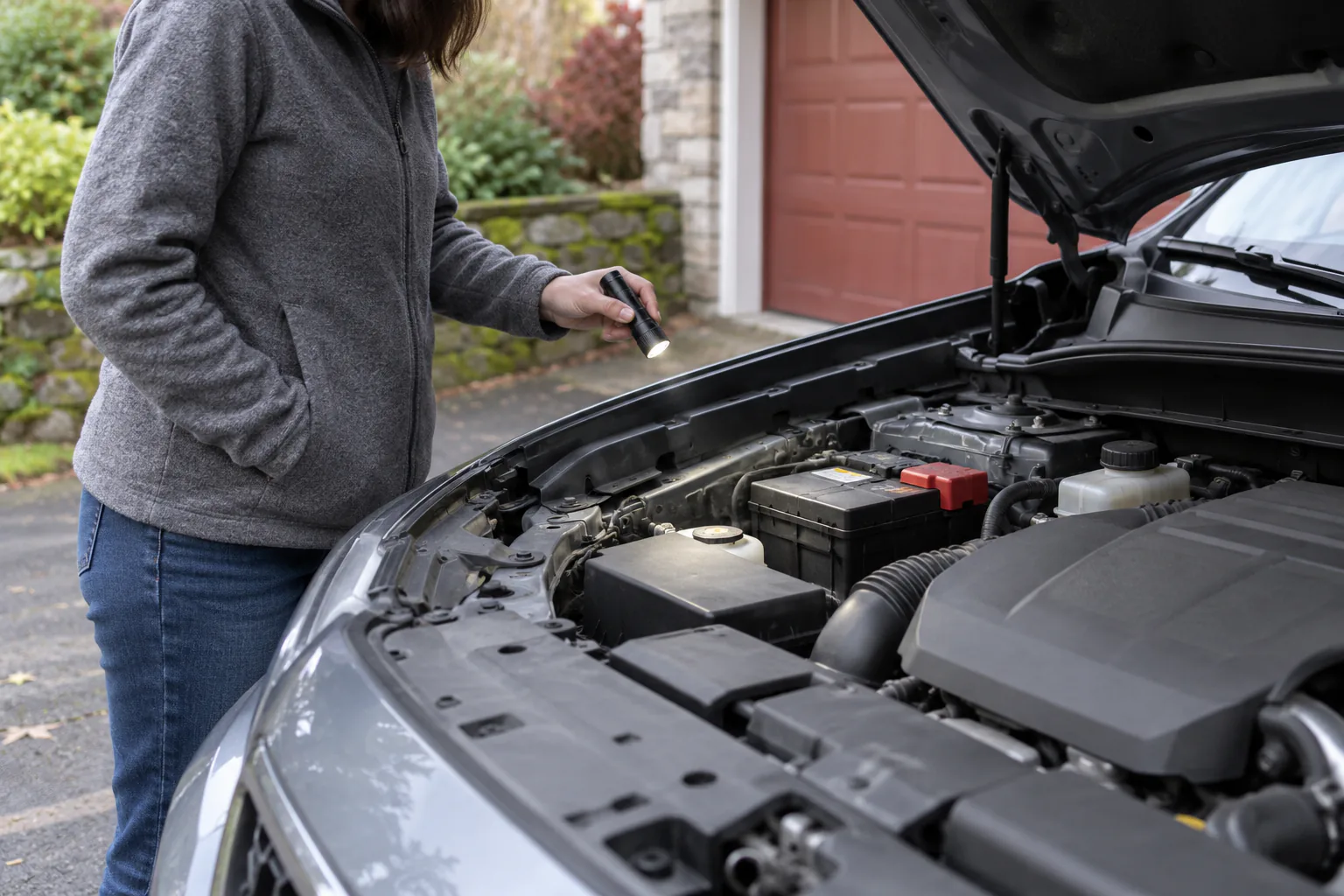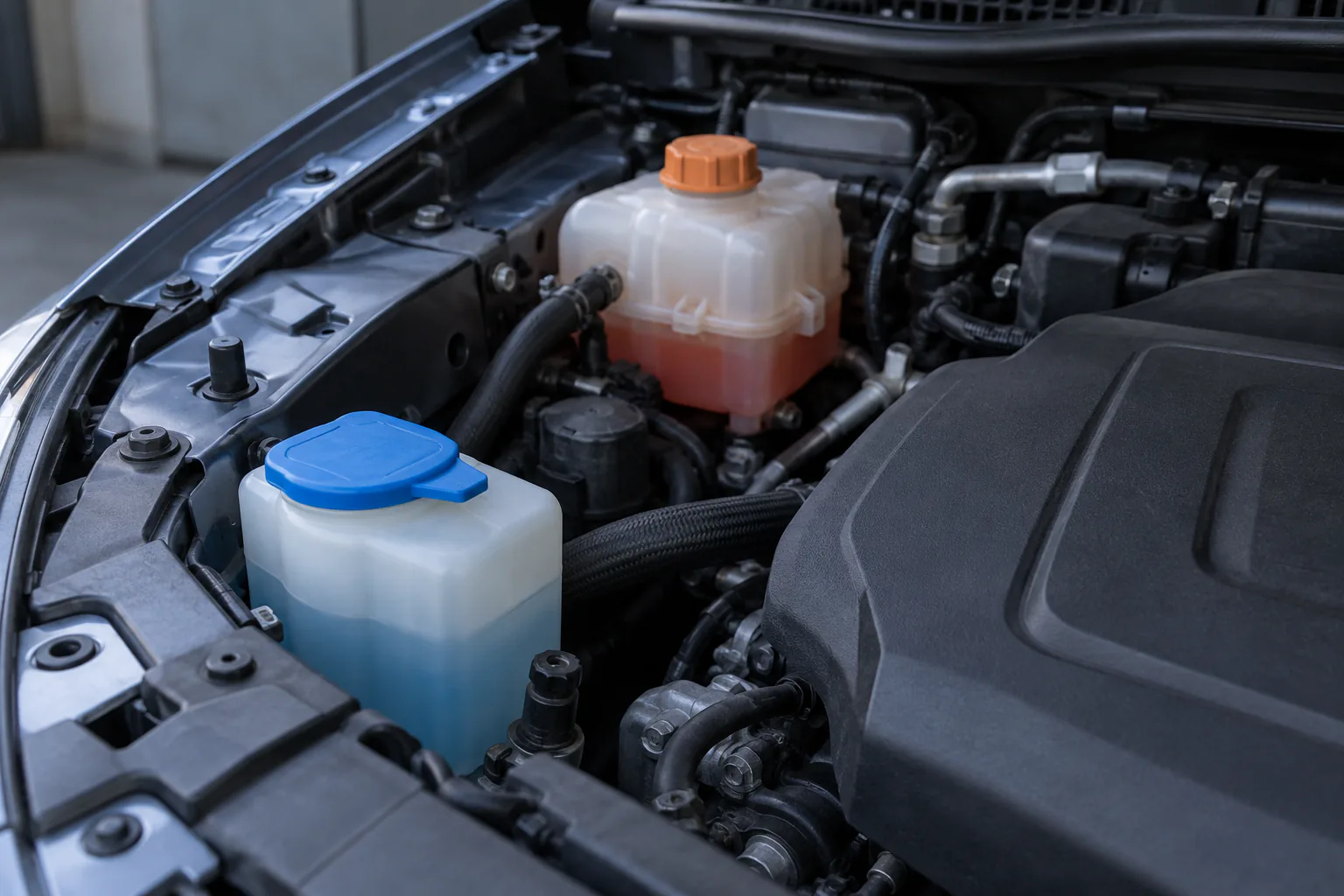
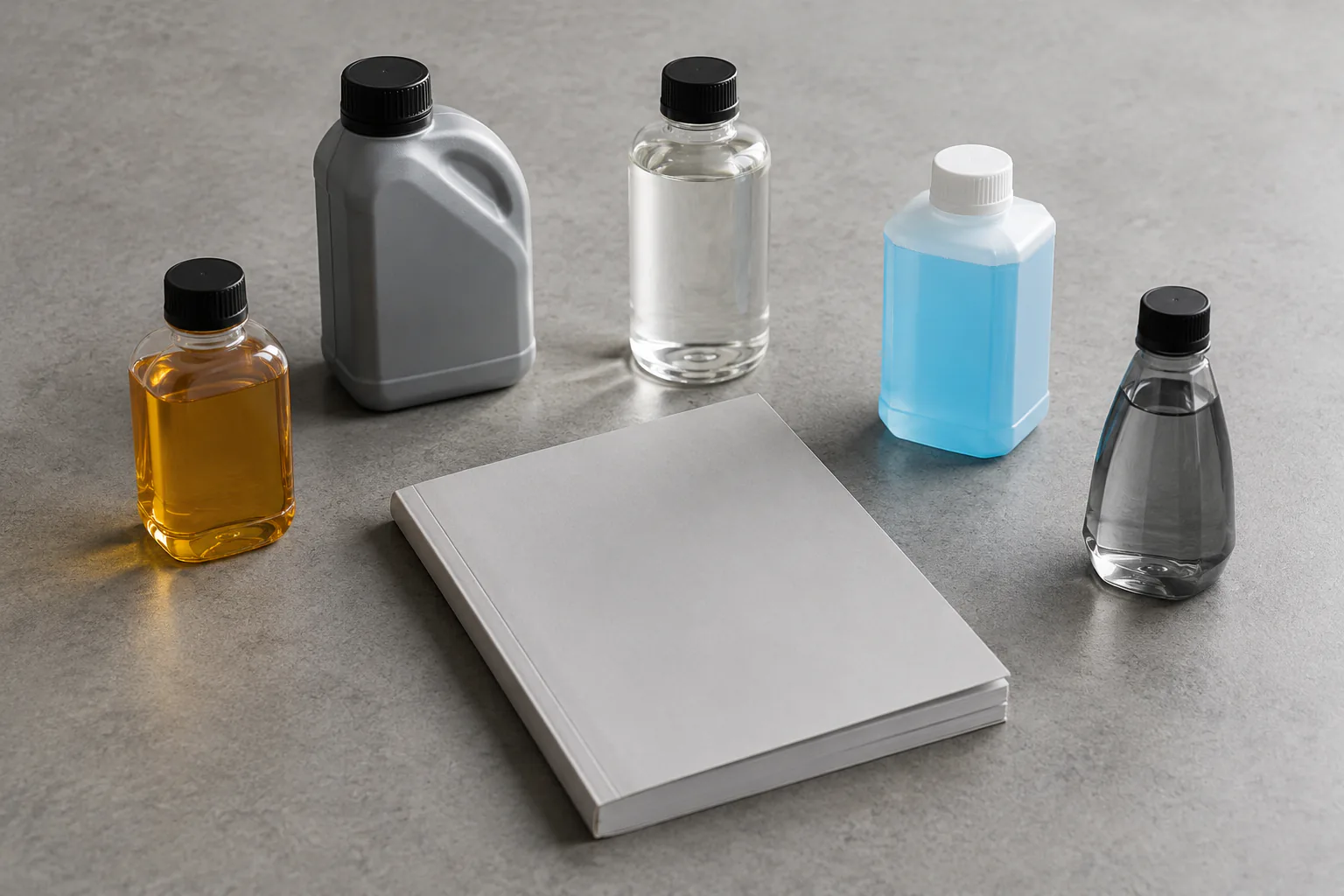
This is a selective map of fluids commonly encountered in current passenger-vehicle owner manuals. Inclusion does not mean every vehicle has the fluid, exposes it to the owner, or permits topping it up. The selection rule is simple: include systems a driver may see referenced in a manual, warning, reservoir, or maintenance schedule, and state the owner boundary for each.
Fluid color is not a reliable identification system. Products change with age, lighting, contamination, and manufacturer formulation. Identify a system by the exact manual, labeled component, location, and specification.
Engine oil
Engine oil lubricates and protects internal engine components. Depending on the vehicle, level may be checked with a dipstick or an electronic display under specified conditions. Use the exact grade and standard in the manual. Too little or too much can be harmful.
A low oil-pressure warning is not merely a request to add oil. Stop the engine as the model-specific manual directs; a correct level does not prove adequate pressure. Repeated level loss, smoke, stains, or unusually high consumption requires investigation.
Owner boundary: check level only by the approved procedure; do not work around a running engine or hot components, and do not confuse pressure warnings with level messages.
Engine or powertrain coolant
Coolant transfers heat and provides freeze, boil, and corrosion protection according to its formulation. A cold reservoir may be owner-checkable, but the system becomes hot and pressurized. Never remove a hot pressure cap.
Use the specified coolant and mixture. Color matching is insufficient. Hybrids and electric vehicles may have more than one cooling circuit, including systems that should be serviced professionally.
Owner boundary: perform only the permitted cold visual check and authorized top-up; treat recurring loss, steam, or temperature warnings as a fault needing attention.
Windshield washer fluid
Washer fluid cleans the windshield and must match expected freezing conditions. The reservoir is commonly owner-fillable and marked with a windshield-spray symbol.
Weak spray can reflect low fluid, freezing, blockage, a leak, or a pump issue. Do not substitute coolant or household chemicals. Keep the product away from children and follow its storage label.
Owner boundary: identify, fill cleanly, close the cap, and test safely.
Brake fluid
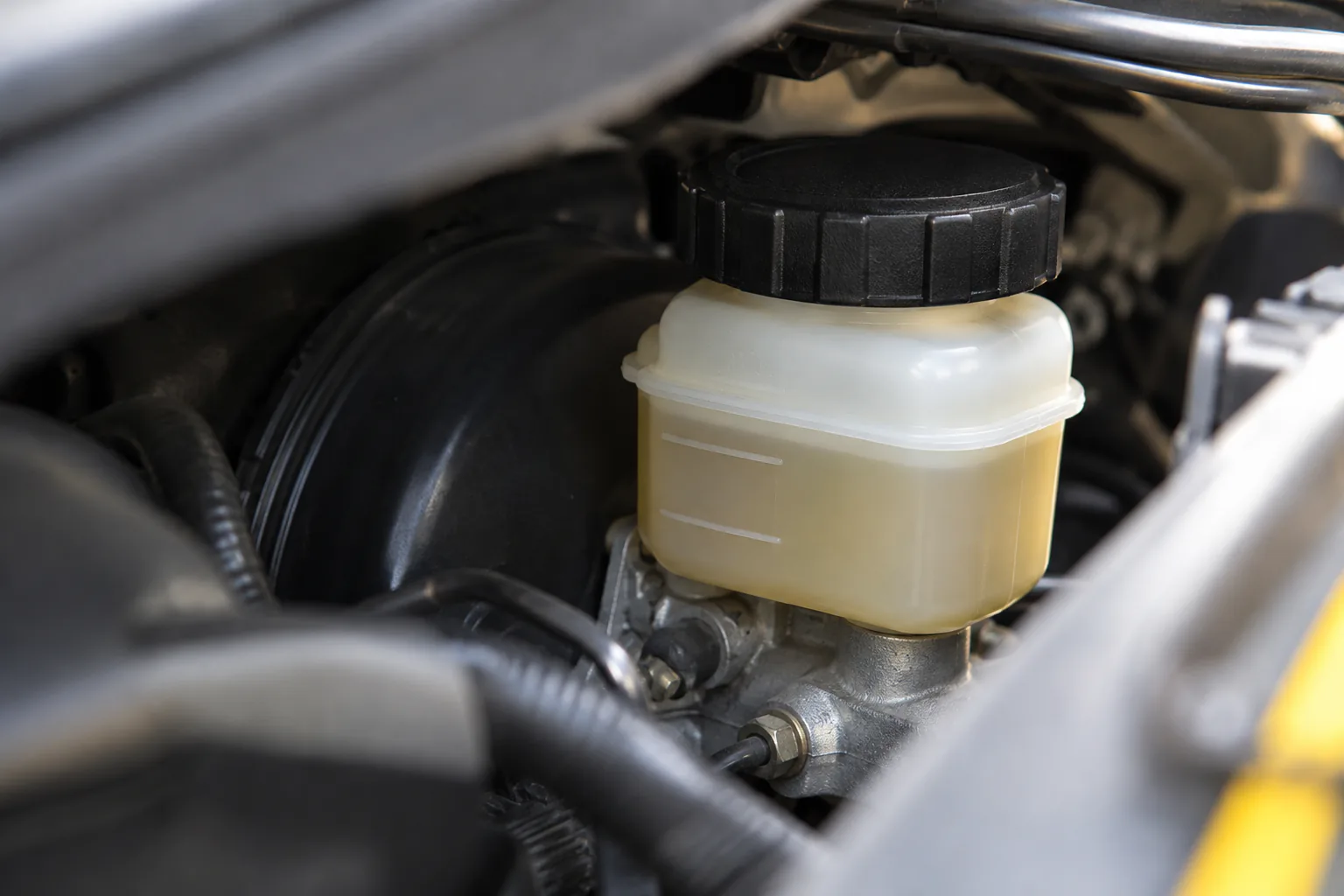
Brake fluid transmits hydraulic force. A low level or brake warning can indicate wear, leakage, or a system problem; adding fluid does not repair the cause. Brake fluid also has vehicle-specific specifications and service requirements.
Owner boundary: observe only if the manual provides a safe method. Do not open the hydraulic system, bleed brakes, or treat a low reservoir as routine consumption. Changed braking or a warning requires prompt model-specific action.
Transmission or transaxle fluid
Transmission-fluid designs vary widely. Some vehicles have a dipstick and defined checking procedure; others require temperature-controlled service equipment or provide no owner check. The specification is exact, and the wrong fluid can cause serious problems.
Hard shifts, delayed engagement, a leak, or a warning needs diagnosis; it does not prove that adding fluid is the answer.
Owner boundary: follow the manual. If no owner procedure exists, do not invent one or remove an unfamiliar plug.
Power-steering fluid, if equipped
Many newer vehicles use electric power steering and have no hydraulic fluid. Hydraulic systems that do exist use a specified fluid and checking state. A whine or heavy steering has several possible causes.
Owner boundary: first confirm that the vehicle has a reservoir and an owner check. Loss or changed steering deserves inspection, not repeated topping-up.
Differential, transfer-case, and gear oils
These fluids lubricate gears in applicable driveline components. They are usually checked or replaced using vehicle-specific service procedures, fill plugs, temperatures, and specifications.
Owner boundary: schedule according to the manual and operating conditions. Do not crawl under an unsupported vehicle or open plugs based on a generic video.
Refrigerant is not a casual top-up fluid
Air-conditioning refrigerant circulates in a sealed, pressurized system and is subject to equipment, environmental, and legal requirements. Poor cooling can result from airflow, controls, sensors, electrical faults, or refrigerant issues.
Owner boundary: check the cabin filter and obvious airflow issues if the manual permits, but leave refrigerant diagnosis and service to qualified equipment and applicable rules.
Build a vehicle-specific fluid card
For each system actually present, record its manual name, location, specification, normal checking condition, service trigger, warning, and owner boundary. Mark absent or sealed systems instead of leaving ambiguous blanks. Include the document page or official URL and access date.
When purchasing fluid, compare the complete approval or specification—not just viscosity, color, or marketing language. Keep containers sealed and labeled; never pour leftovers into an unidentified bottle. Dispose of used automotive fluids through an appropriate local program rather than drains, soil, or household trash where prohibited.
Handle recommendations and leaks by system
When a shop recommends a fluid service, ask whether it comes from the manufacturer schedule, a measured condition, contamination, repair work, or shop policy. Request the exact fluid specification, service method, quantity basis, and reason. “Flush all fluids” is not a model-specific explanation.
When a leak appears, record its location, amount, recurrence, odor or texture without contact, and related symptoms. Clear air-conditioner condensation can be normal; a fuel odor, brake-fluid loss, steam, overheating, or rapid oil loss requires a very different response. Fluid color alone cannot make that decision.
After service, the invoice should identify the system and product clearly. A generic line such as “fluid service” is difficult to audit later. Save the date, mileage, brand or product where relevant, complete specification, and unresolved findings. If a system was opened for repair, ask whether bleeding, level setting, temperature control, or scan-tool procedures were required and documented.
Do not mix a small amount of a guessed product simply to reach a shop. Cross-contamination can be more difficult to correct than the original low level. When the manual's approved product is unavailable, obtain model-specific guidance rather than treating similar color or container language as compatibility evidence.
Special cases: hybrids, EVs, and modified vehicles
Electrified vehicles may retain ordinary washer and brake fluids while adding power-electronics, motor, gearbox, or battery thermal-management systems. Orange cables and marked enclosures are high-voltage boundaries. Some coolant circuits are not owner-serviceable.
Modified drivetrains, aftermarket coolers, and swapped components may no longer match the original fluid card. Preserve installation documents and specifications. The original manual remains useful for unchanged systems, but it cannot silently authorize the modification's service needs.
The safest roundup is not a shopping list. It is a map of different systems with different hazards. Identify the vehicle first, separate observation from service, and treat unexplained loss or a warning as evidence to investigate rather than a reason to keep topping up.