
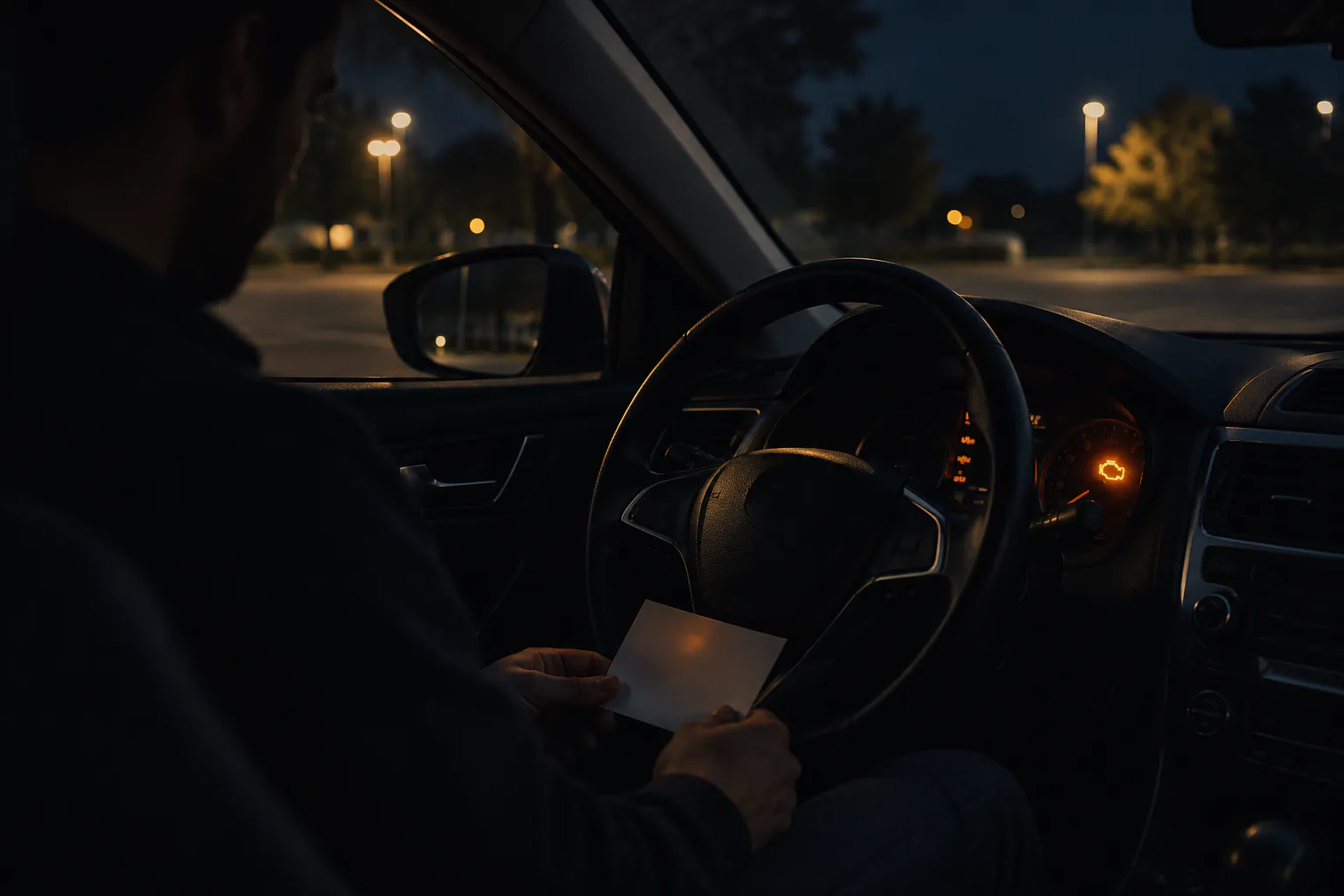
The check-engine light, also called the malfunction indicator lamp, tells you that onboard diagnostics detected a condition. It does not tell you which part to replace. A loose fuel cap, emissions fault, sensor issue, wiring problem, or misfire can all produce diagnostic information, and the same code can have more than one cause.
Your first decision combines light behavior, vehicle operation, temperature, odor, noise, other warnings, and the model-specific manual. A steady lamp is not a universal promise that driving is safe, and a flashing lamp deserves urgent attention.
Capture the event
Note whether the light is steady or flashing, when it appeared, fuel level and recent refueling, weather, speed or load, and whether starting, idle, acceleration, shifting, temperature, smoke, odor, or sound changed. Photograph the full display after stopping safely.
Confirm that the icon is the check-engine lamp, not a maintenance reminder, master warning, or powertrain symbol. Some vehicles display explanatory messages. Read the exact manual.
Respond to a flashing light
EPA consumer material explains that a blinking lamp can indicate a severe problem such as a catalyst-damaging misfire and advises minimizing driving, avoiding high speed and excess load, and seeking repair quickly. That historical federal guidance is useful background; the current vehicle manual and actual symptoms control the safest action.
If flashing is paired with shaking, major power loss, overheating, smoke, fuel odor, loud mechanical noise, or another stop warning, pull over safely, switch off as directed, and arrange transport. Do not continue to see whether it clears.
Even without dramatic symptoms, reduce load and obtain urgent model-specific guidance. Towing may be the safer choice when distance, traffic, or vehicle behavior makes continued operation risky.
Respond to a steady light
EPA says a steady lamp means the OBD system detected a problem that needs attention. Check the manual and vehicle behavior. If operation is normal and no urgent warning exists, schedule diagnosis soon rather than ignoring it.
After safely reaching a destination, a loose or missing fuel cap may be checked if the vehicle uses one and the manual identifies that possibility. Turn the engine off before refueling. Tightening a cap does not clear every light immediately and should not become a default diagnosis.
Stop or seek urgent help if a steady lamp accompanies overheating, oil-pressure or brake warnings, smoke, fuel odor, serious misfire, major power loss, or unsafe operation. Symptoms outrank the word “steady.”
Understand what a code can and cannot do

An OBD scanner retrieves diagnostic trouble codes and data. A code points to a detected circuit, performance condition, or system monitor; it does not automatically name the failed component. Replacing the part whose name resembles the code can waste money and leave the root cause.
A proper diagnosis may use freeze-frame data, service information, visual inspection, electrical tests, smoke or pressure tests, and manufacturer procedures. Do not erase codes before diagnosis unless a qualified plan calls for it; clearing can remove useful data and reset emissions monitors.
Consumer scanners and parts-store reads can document a code, but they are not equivalent to a completed diagnosis. Record the exact code and description with the date and operating condition.
If the light turns off
EPA explains that OBD can turn the lamp off after the condition no longer occurs for the required trips. An extinguished lamp does not prove that every intermittent issue is repaired or that stored information vanished.
If the light returns, symptoms occurred, or an inspection/emissions deadline matters, arrange evaluation. Preserve the earlier photograph and code. Do not disconnect the battery simply to clear the lamp; that can erase data and affect vehicle settings.
Prepare for the shop
Provide the timeline, light behavior, symptoms, recent fueling or repairs, maintenance history, codes already read, and any changes after the light went out. Ask what diagnostic testing is included and whether a fee applies.
Request the confirmed cause, supporting test, manufacturer procedure, completed repair, and post-repair verification. The EPA describes technicians using scan information and manufacturer-recommended protocols; the repair should go beyond downloading a code.
Avoid the parts-cannon sequence
A common failure pattern is to read a code, replace the component named in its description, clear the light, and repeat when it returns. Codes describe what the control system detected. They can be produced by wiring, connectors, air or vacuum leaks, contamination, mechanical faults, software, or another upstream condition.
Ask the technician to state the testable hypothesis and result. For an oxygen-sensor-related code, for example, the diagnosis may need circuit checks, exhaust or intake leak evaluation, fuel-trim data, and sensor behavior. The code alone does not decide the sensor is defective.
Do not install a fuel cap, ignition coil, sensor, or catalyst based only on a generic “most common cause” list. Frequency across other vehicles is not evidence for this vehicle. If a low-cost first step is proposed, ask what outcome will confirm or reject it.
Inspection and emissions implications
Clearing codes resets readiness monitors on many vehicles. That can delay an emissions inspection and erase freeze-frame information useful for diagnosis. Battery disconnection can have the same effect and may reset other learned settings.
If an inspection deadline is approaching, tell the repairer before codes are cleared. Ask what drive-cycle or monitor completion is required after repair, but do not perform an unsafe or illegal driving pattern merely to set readiness.
A light that turns off can leave stored or permanent information depending on the system. Qualified tools and current service information should determine whether the repair is verified.
Verify resolution
After service, confirm normal operation, warning status, and any required drive-cycle or emissions-monitor readiness information. Keep the invoice, codes, test results, parts, and warranty. If the lamp returns, report whether it is the same code or symptom rather than assuming the first repair failed for the same reason.
The light is a request for diagnosis. Flashing, serious symptoms, and companion warnings increase urgency; a steady lamp with normal operation usually allows an orderly appointment only when the manual agrees. Record first, reduce risk, and let testing connect the code to the actual cause.
If the vehicle enters reduced-power mode, treat the change in acceleration and traffic integration as a safety factor. A manual that allows limited driving still does not guarantee that a busy highway or heavy load is an appropriate route.