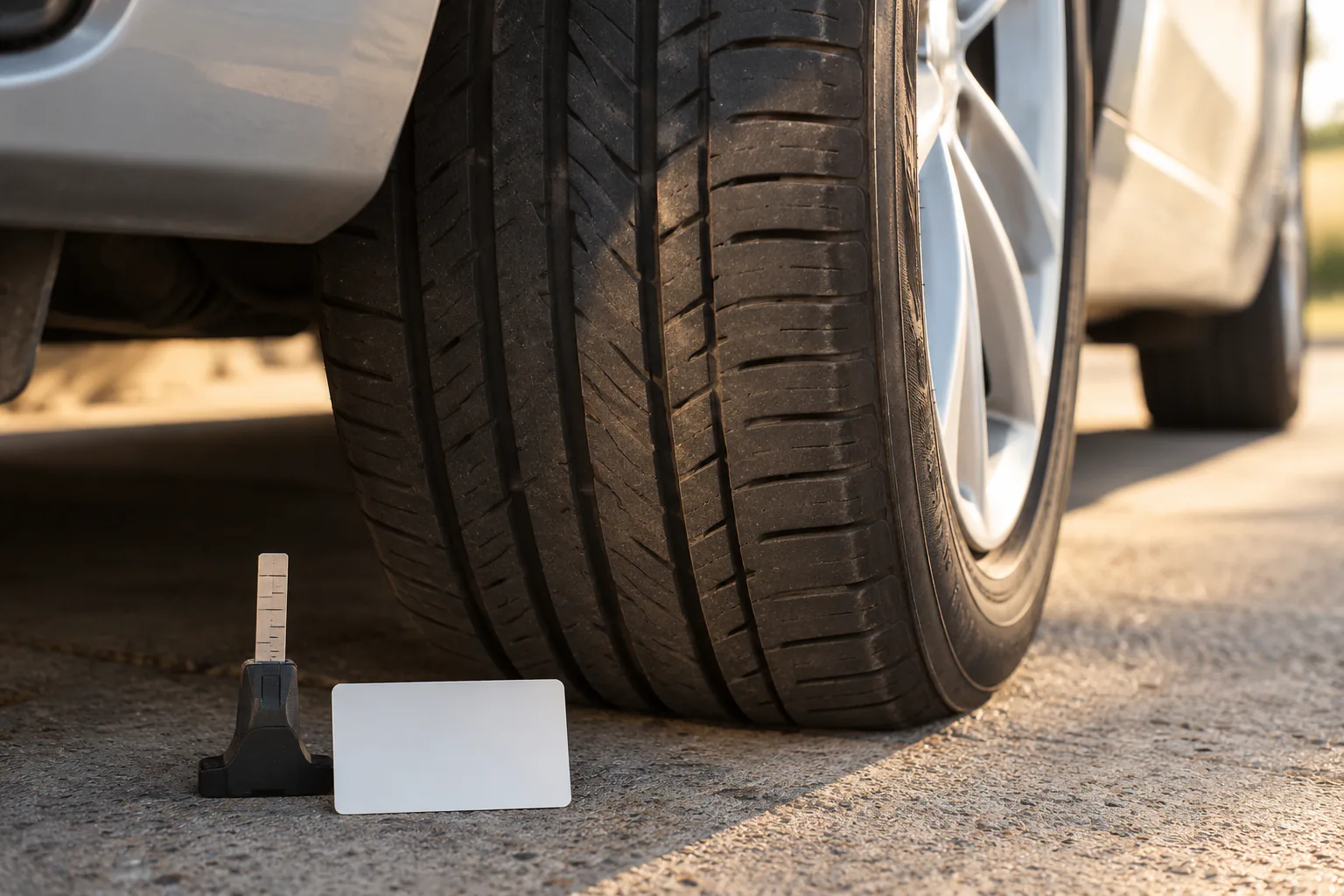
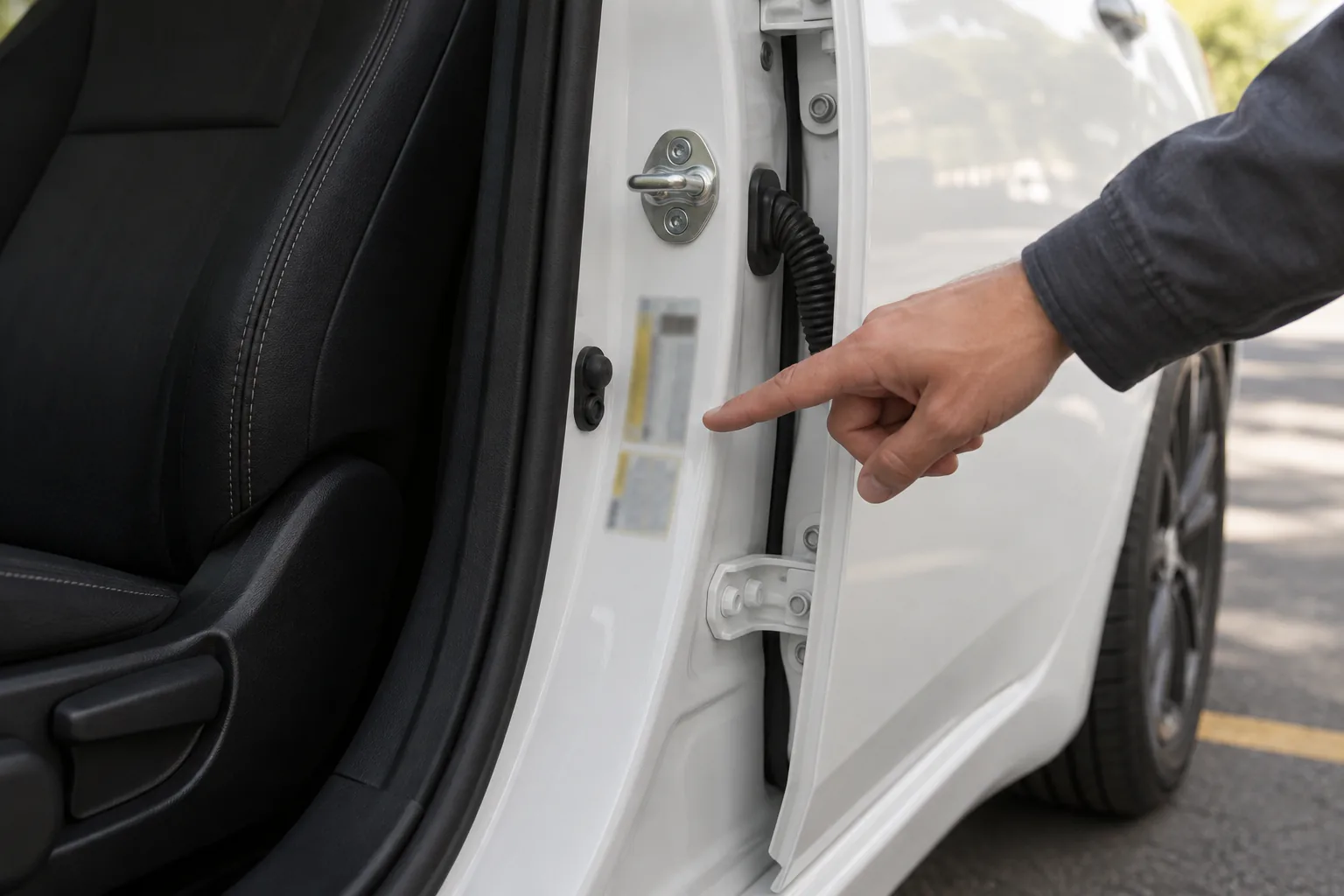
The Tire and Loading Information label is a vehicle data source, not a complete tire manual. It normally identifies the original tire size, recommended cold inflation pressure, seating capacity, and a maximum combined weight for occupants and cargo. It does not tell you that a damaged tire is safe, diagnose uneven wear, or make every replacement choice automatically.
Find the label on the driver's door edge or door pillar; NHTSA notes alternative nearby locations when a conventional pillar or edge is unavailable. Confirm that you are reading the vehicle label, not a tire sidewall or an unrelated certification sticker. If the label is missing or unreadable, use the exact owner's manual or manufacturer support rather than guessing.
Read recommended cold pressure by position

The pressure line may list separate front and rear values in psi and kPa. Match each value to its axle. NHTSA states that the recommended pressure on this label or in the owner's manual is the proper cold inflation target—not the maximum pressure on the tire sidewall.
“Cold” means the vehicle has been parked long enough to avoid normal driving heat affecting the reading; NHTSA uses at least three hours. Pressure rises as a tire warms, so bleeding a warm tire down to the cold target can leave it underinflated later. If a warm tire appears low, follow official guidance and recheck cold.
The label may list a compact or full-size spare separately. Check the manual for access and pressure. Some vehicles have no spare, or use a mobility kit with different maintenance needs.
Decode the listed tire size carefully
A passenger-tire size can combine width, aspect ratio, construction, rim diameter, and load or speed information. The vehicle label identifies an approved original configuration, while the tire sidewall carries the tire's own full markings.
Do not use one matching number as proof of compatibility. Replacement decisions must account for size, load capacity, speed capability, construction, axle matching, wheel fit, vehicle systems, and manufacturer guidance. NHTSA advises using the same size as the original tires or another size recommended by the vehicle manufacturer and consulting a tire dealer when uncertain.
If front and rear sizes differ, rotation may be restricted or impossible. NHTSA specifically notes that some staggered setups cannot follow ordinary rotation patterns. The label helps reveal the setup, but the owner's manual supplies the permitted pattern.
Understand seating and load language

The occupant-and-cargo statement limits combined weight, not the number of objects that fit. Passengers, luggage, accessories, and other cargo all contribute. Towing adds further vehicle-specific ratings and tongue-load considerations that are not fully explained by this one label.
Do not subtract a guessed “average person” unless the owner's information provides the calculation method. Consult the manual for loading instructions and do not exceed axle, tire, hitch, or vehicle ratings. Correct inflation does not make overloading safe.
When the vehicle is carrying a different load, use only pressure changes authorized by the manufacturer. The sidewall maximum is not a substitute load setting.
What TPMS adds—and what it does not
TPMS monitors for underinflation or system faults according to its design. NHTSA says the warning generally indicates at least one tire is significantly underinflated, and that a flashing sequence followed by steady illumination can indicate a malfunction. The system is not a substitute for monthly gauge checks.
After rotation, replacement, seasonal wheel changes, or pressure adjustment, the vehicle may require a model-specific initialization or relearn. Follow the exact manual. Do not clear a warning simply to make the dashboard quiet.
When the label no longer describes the whole setup
Aftermarket wheels, alternative approved sizes, accessibility conversions, unusual loading, or a replacement label can create questions the original sticker alone cannot resolve. Record the current tire and wheel markings and consult the vehicle manufacturer, qualified tire professional, or documentation for the approved configuration.
A previous owner's modification is not proof of compatibility. Ask for supporting records. If the tire's load rating, size, clearance, or system compatibility is uncertain, resolve it before high-speed, heavily loaded, or long-distance use.
Create a label record without exposing personal data
Photograph the label clearly and store it with the vehicle records. Capture the values in a note: front pressure, rear pressure, spare pressure if listed, original tire size or sizes, seating statement, and load statement. Do not include a VIN if sharing the image publicly.
Then verify the note against the owner's manual. A transcription error can become a repeated inflation error. Recheck the original label after editing any reminder or spreadsheet.
Avoid five common label mistakes
Do not copy the sidewall maximum into a pressure reminder. Do not assume front and rear values match. Do not overlook the spare's separate requirement. Do not treat seating capacity as permission to exceed the combined occupant-and-cargo limit. Do not assume an aftermarket tire is approved merely because its rim diameter matches.
Another common error is reading a value after the vehicle has been driven and “correcting” it down to the cold target. The label specifies a cold reference. Follow NHTSA and manufacturer instructions for a warm tire, then recheck after the required cooling period.
Finally, distinguish the label from the certification label and VIN plate. Several stickers may share the door area. Use the heading and field descriptions, and preserve a full photograph so the context remains visible. A cropped pressure number with no axle or unit is easy to misuse.
What the label cannot decide
It cannot establish current pressure without a gauge, current tread depth without measurement, or internal condition without inspection. It cannot tell you that a puncture is repairable, explain every TPMS warning, set a universal rotation interval, or determine when aging requires replacement. Those questions need the tire condition, exact manual, manufacturer guidance, and sometimes professional inspection.
Read the label as a compact vehicle specification: match position to cold pressure, confirm the approved size and load context, and preserve the data accurately. Its strength is precision. Its limitation is scope.
If a value seems implausible, stop and verify through the exact manual or manufacturer rather than averaging it with a number found online. The correct result may genuinely differ by axle, tire package, market, or loading condition.
Keep units attached to every copied number. Confusing psi with kPa, or omitting which axle a value belongs to, can turn an accurate label into an unsafe reminder.